
Plumbing Services
Well Pressure Tank Repair & Replacement in Rittman & Akron, OH
*In Home Only
When your well pressure tank isn’t working right, you’ll feel it at every faucet in your home—fluctuating water pressure, a pump that won’t stop cycling, or fixtures that barely produce a stream. Schar Heating & Cooling provides well pressure tank repair and replacement for homeowners in Rittman and Akron, OH. Whether you’re dealing with pressure drops, short cycling, or a tank that’s waterlogged and failing, we’ll find the problem and get your water flow stabilized.

⚠️ Signs Your Well Pressure Tank Has a Problem
Your pressure tank works alongside your well pump to maintain steady, consistent water pressure throughout your home. When the tank starts to fail, the symptoms can show up gradually or all at once. Here’s what to watch for:
- Water pressure that spikes and drops repeatedly
- The well pump is cycling on and off rapidly (short cycling)
- Sputtering or spitting at the faucets when you first turn them on
- A noticeable drop in overall water pressure throughout the house
- The pump runs constantly and doesn’t seem to shut off
- Visible water leaking from the tank or its fittings
- The tank feels completely heavy and waterlogged when tapped
- Higher-than-normal electric bills from the pump running too frequently
Short cycling is one of the most common and most damaging symptoms of a pressure tank problem. When the tank can’t hold its air charge, the pump has to kick on and off far more often than it should. This doesn’t just affect your water pressure—it puts serious wear on the well pump, which is a much more expensive component to replace.
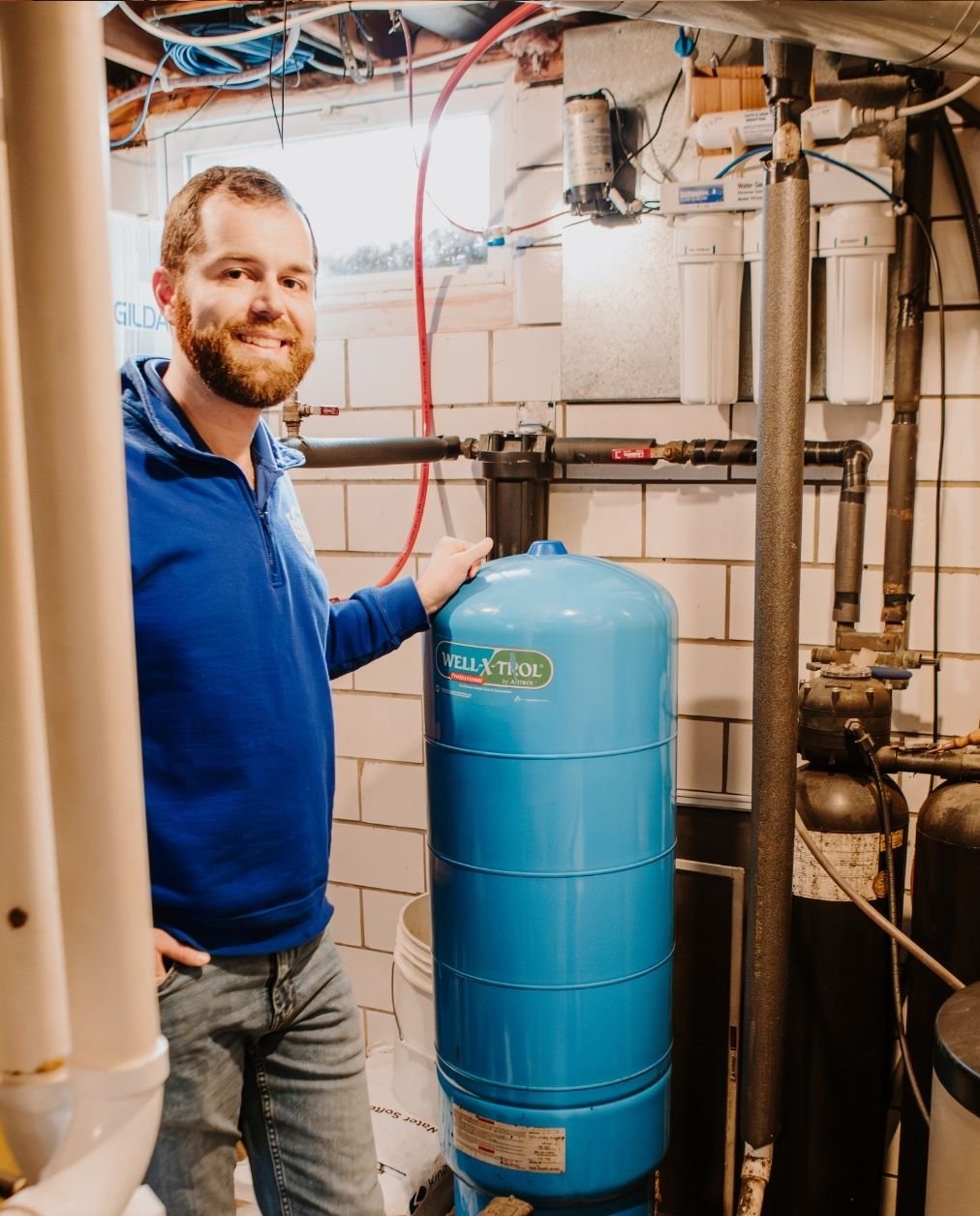
🧰 Our Well Pressure Tank Repair Process
Not every pressure tank issue means you need a brand-new tank. Some problems are caused by a faulty pressure switch, a bad gauge, a leaking fitting, or a tank that just needs its air charge adjusted. Our technicians start by testing the full system to pinpoint where the problem actually is before recommending any work.
We check the tank’s pre-charge pressure with a gauge to see if the air bladder is still holding. We test the pressure switch to make sure it’s activating the pump at the correct cut-in and cut-out points. We inspect all fittings and connections for leaks, and we evaluate the pump’s performance to make sure the issue is actually the tank and not something upstream.
If the tank’s bladder is intact and the problem is a misadjusted pressure switch, a faulty gauge, or a slow leak at a fitting, we can often make the repair on the spot and restore normal operation the same day.
Common repairs we handle include:
- Pressure switch adjustment or replacement
- Air charge correction on the tank bladder
- Pressure gauge replacement
- Leak repair at fittings, connections, or the tank itself
- Electrical connection and wiring repairs
🔄 When a Pressure Tank Needs to Be Replaced
Pressure tanks have a typical lifespan of about 10 to 15 years, but that can vary depending on water quality, how often the pump runs, and whether the tank has been maintained. When the internal bladder ruptures—which is the most common failure point—the tank fills completely with water and can no longer maintain an air cushion to regulate pressure. At that point, replacement is the only real fix.
A waterlogged tank is easy to spot. If you tap on the side of the tank and it sounds solid from top to bottom—instead of hollow near the top where the air pocket should be—the bladder has almost certainly failed. You’ll also notice the pump short cycling and your pressure swinging noticeably between fixtures.
Other situations where replacement is the right call:
- The tank’s bladder has ruptured and the tank is waterlogged
- Visible corrosion, rust-through, or structural damage on the tank
- The tank is undersized for your household’s water demand
- Repeated pressure problems that don’t resolve with repairs
- The unit is past the 10-to-15-year mark and showing its age
Every replacement includes draining and removing the old tank, installing the new unit with proper fittings and connections, setting the correct pre-charge pressure for your system, calibrating the pressure switch, and testing the full cycle to make sure everything holds steady.
🔍 Choosing the Right Pressure Tank Size
One of the most important factors in a well pressure system is making sure the tank is properly sized for your household. An undersized tank causes the pump to cycle more frequently, which wears out the pump faster and creates the kind of pressure fluctuations you’re trying to avoid. An oversized tank won’t hurt anything, but it costs more than you may need.
Tank sizing is based on the flow rate of your well pump and the desired run time between pump cycles. The goal is to store enough pressurized water that the pump doesn’t have to kick on every time someone turns on a faucet. For most residential systems, this means choosing a tank that gives the pump at least a one-minute rest between cycles.
Small households (1–2 people) with modest water usage can often get by with a 20- to 30-gallon tank, depending on the pump’s flow rate.
Average households (3–4 people) typically do well with a 30- to 50-gallon tank, which provides enough stored water to handle showers, laundry, and dishwashers running without triggering rapid cycling.
Larger households or homes with high demand—multiple bathrooms, irrigation systems, or livestock—may need a 50-gallon tank or larger to keep the pump from overworking.
Our team will assess your well pump’s flow rate, your household’s typical water use, and your current system setup to recommend the right size. Getting this right up front saves you from premature pump wear and ongoing pressure problems.
🛠️ Getting the Most Life Out of Your Pressure Tank
A well pressure tank is a fairly low-maintenance piece of equipment, but the few things that do need attention make a big difference in how long the tank lasts and how well your system performs.
Check the air pre-charge once or twice a year. The tank should be pre-charged to about 2 PSI below the pressure switch’s cut-in setting. If the charge drops too low, the bladder flexes more than it should with every cycle, which wears it out faster. A standard tire gauge on the tank’s air valve is all you need to check it—just make sure the pump is off and the system is depressurized first.
Listen for short cycling. If you hear the pump kicking on and off every few seconds or every time a fixture is used, don’t ignore it. Short cycling is the number one cause of premature pump failure and is almost always a sign that the tank isn’t holding pressure correctly.
Watch for moisture or corrosion on the tank. Condensation on the outside of the tank is normal in humid conditions, but actual dripping, rust spots, or soft areas on the tank body are signs of trouble. Catching corrosion early can help you plan a replacement before the tank fails unexpectedly.
Keep the area around the tank clear. Your pressure tank and pressure switch need to be accessible for inspection and maintenance. Avoid stacking storage against the tank, and make sure the wiring and plumbing connections are easy to reach.
Have your water tested periodically. Acidic or mineral-heavy water can shorten the lifespan of both the tank bladder and the tank itself. If your water quality is aggressive, there are treatment options that can protect your equipment and extend the life of your system.
❓ Well Pressure Tank Repair & Replacement FAQ
How do I know if my pressure tank is waterlogged?
Tap on the side of the tank from top to bottom. A healthy tank will sound hollow near the top where the air charge is and solid near the bottom where the water sits. If it sounds solid all the way through, the bladder has likely failed and the tank is waterlogged. You’ll usually also notice short cycling and inconsistent pressure.
How long does a pressure tank last?
Most residential pressure tanks last between 10 and 15 years. Factors like water quality, how often the pump runs, and whether the air charge is maintained properly can push that lifespan longer or shorter.
What’s the difference between the pressure tank and the well pump?
The well pump pulls water from the well and pushes it into the pressure tank. The pressure tank stores that water under pressure and delivers it to your home’s fixtures on demand. The two work together—if the tank fails, the pump has to work much harder, and if the pump fails, the tank can’t refill. Most pressure-related symptoms start with the tank, which is the less expensive of the two to replace.
Can a bad pressure tank damage my well pump?
Yes. When the tank can’t hold its air charge, the pump short cycles—turning on and off far more frequently than it’s designed to. This puts serious stress on the pump motor and can cut its lifespan significantly. Fixing or replacing a failing tank promptly is one of the best ways to protect your well pump.
My water pressure is low—is it definitely the pressure tank?
Not necessarily. Low pressure can also be caused by a failing well pump, a clogged pressure switch, a partially closed valve, or even a plumbing issue inside the home. That’s why we test the full system before making a recommendation. If the tank checks out, we’ll identify where the real problem is.
How long does a pressure tank replacement take?
Most replacements take two to three hours, including draining the old tank, installing the new one, setting the pre-charge, calibrating the pressure switch, and testing the system through several full cycles to make sure everything is working correctly.
Call Your Local Plumbing Experts Today
Our team of certified experts at Schar can take care of all your home Plumbing needs. Call our Rittman or Akron, OH, office today.